GOD THE HOLY TRINITY
ONE GOD IN THREE DIVINE PERSONS: FATHER, SON, AND HOLY SPIRIT
(Mt 28:19; Jn 1:1–18; Jn 14–16; 2 Cor 13:13; Eph 1:3–14; CCC 232–267)
Biblical Identity and Primary References
The Holy Trinity is the central mystery of the Christian faith: one God in three distinct but inseparable Persons—Father, Son, and Holy Spirit. Each Person is fully God, co-eternal, co-equal, and consubstantial, sharing the same divine nature. This truth is revealed progressively in Scripture and fully in Jesus Christ. Jesus commands baptism “in the name of the Father, and of the Son, and of the Holy Spirit” (Mt 28:19), revealing both unity (one name) and distinction (three Persons). The apostolic blessing also reflects this Trinitarian structure: “The grace of the Lord Jesus Christ, the love of God, and the fellowship of the Holy Spirit be with all of you” (2 Cor 13:13).
Historical and Cultural Background
In the ancient world, polytheism was widespread, and Jewish faith emphasized strict monotheism: “Hear, O Israel: The LORD our God is one” (Deut 6:4). Christianity did not abandon this monotheism but deepened it through divine revelation. Jesus did not introduce three gods; He revealed the inner life of the one God. The early Church, guided by the Holy Spirit, clarified this mystery through prayer, Scripture, and doctrinal reflection, especially in the Councils of Nicaea (325) and Constantinople (381), which articulated the Creed still professed today.
Progressive Revelation in Scripture
In the Old Testament, God is revealed as Creator, Covenant-Maker, Lawgiver, and Father of Israel (Deut 32:6; Isa 63:16). The Word of God and the Spirit of God appear as divine agents (Gen 1:2; Ps 33:6), preparing for fuller revelation. In the New Testament, Jesus reveals God as Father in a unique way, calling Him “Abba” (Mk 14:36), claiming divine Sonship (Jn 5:18), and promising the Holy Spirit as Advocate (Jn 14:16–17). At Jesus’ Baptism, the Trinity is manifest: the Father’s voice, the Son in the water, and the Spirit descending like a dove (Mt 3:16–17).
Distinct Persons, One Divine Nature
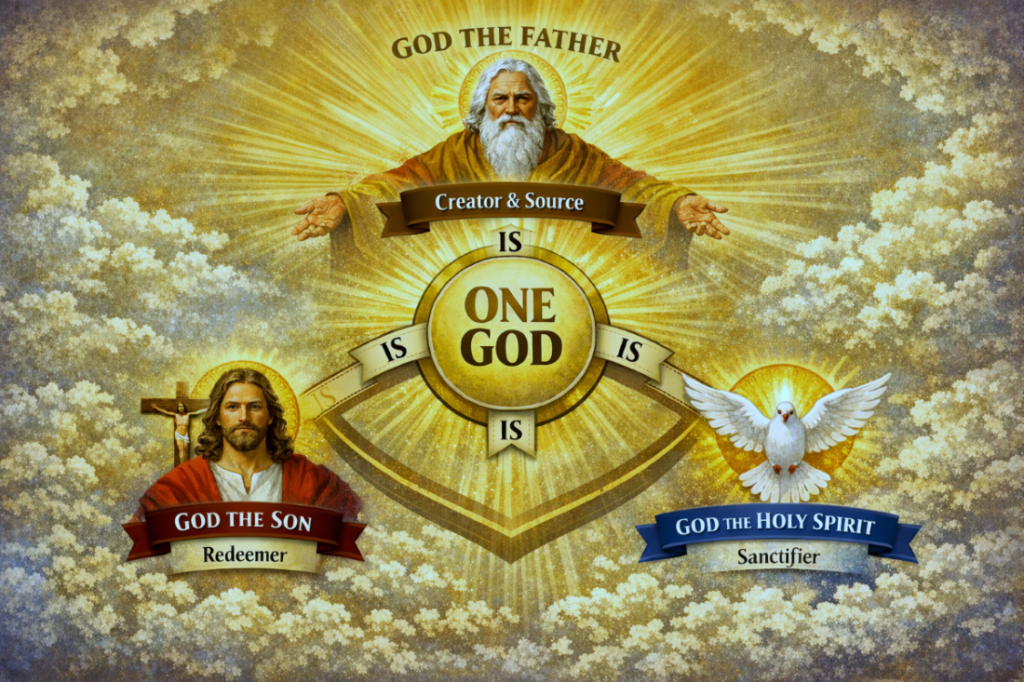
The Father is unbegotten, the eternal source of divine life. The Son is eternally begotten of the Father, not created. The Holy Spirit eternally proceeds from the Father and the Son. These distinctions are not divisions of God but eternal relationships within the one divine essence. The Trinity is not a puzzle to be solved but a mystery to be adored.
References in Other Parts of the Bible
Creation reflects Trinitarian action: the Father creates through the Son in the power of the Spirit (Gen 1:1–3; Jn 1:3; Ps 104:30). Redemption is Trinitarian: the Father sends the Son; the Son redeems humanity; the Spirit sanctifies believers (Eph 1:3–14). Prayer is Trinitarian: we pray to the Father, through the Son, in the Holy Spirit (Rom 8:15; Eph 2:18).
Jewish Roots and Christian Fulfillment
Judaism affirmed one God. Christianity preserved this faith while recognizing that God’s unity is relational. The Trinity fulfills Israel’s hope: God is not solitary but communion. Love is not an attribute God later acquired; God is eternally love (1 Jn 4:8) because within God exists eternal self-giving.
Catholic Interpretation and Teaching
The Church teaches that the Trinity is “the central mystery of Christian faith and life” (CCC 234). All Christian doctrines flow from it. The Father is the source, the Son is the Word, and the Holy Spirit is the Love between them. The Trinity is revealed not as an abstract idea but as the living God who enters human history. The sacraments, especially Baptism and Eucharist, immerse believers into Trinitarian life.
Connection to Salvation History
The Father creates and calls. The Son redeems and reveals. The Holy Spirit sanctifies and transforms. Salvation is participation in the Trinitarian life. Through Christ, believers are adopted as children of the Father and made temples of the Holy Spirit (Rom 8:14–17; 1 Cor 6:19).
Typology and New Testament Fulfillment
Old Testament hints—God’s Word, God’s Spirit, divine Wisdom—are fulfilled in Christ and Pentecost. The Trinity becomes visible in the mission of the Church, where believers live as icons of divine communion.
What Makes the Trinity Unique
God is not isolated power but eternal communion. The Trinity reveals that relationship is at the heart of reality. Love is not secondary to God—it is God’s very being.
Strengths and Divine Perfections
The Father: origin, providence, mercy.
The Son: truth, redemption, revelation.
The Holy Spirit: sanctification, unity, renewal.
Human Limitations in Understanding
The Trinity surpasses human logic. It can be known only by revelation, not by reason alone. It invites humility, worship, and trust.
Lessons for Christian Life and Witnessing
Christians are called to reflect Trinitarian love: unity without uniformity, diversity without division, communion without confusion. The Trinity teaches mutual self-giving, obedience, and love.
Conclusion
The Holy Trinity is not a theory but the living God. To know God is to enter into communion with Father, Son, and Holy Spirit. Christian life is participation in divine love.
Reflection
Every act of love mirrors the Trinity. Every prayer, every sacrament, every act of mercy draws us into God’s inner life. The Trinity teaches us that we are not made for isolation but for communion.
Prayer
Glory to the Father, and to the Son, and to the Holy Spirit, as it was in the beginning, is now, and ever shall be, world without end. O Most Holy Trinity, draw us into Your life of love, transform us by Your grace, and make us instruments of Your peace. Amen.